


I watched on my NYC block how dog pee behavior changed in days. WThis was no coincidence, but the result of a Dog Pee Rest Area being established which aligned the reality of dogs peeing where other dogs pee with the designs appeal to convenience, meeting dog walkers where they are.
Many dog pee interventions fail because they try to tell the humans to behave differently without making the behavior easier.
If you’re curious about the design thinking logic behind the idea, you’ll find the framework here. If you want to try something similar in your neighborhood, you’ll also find a practical pilot plan.
How dogs choose where to pee
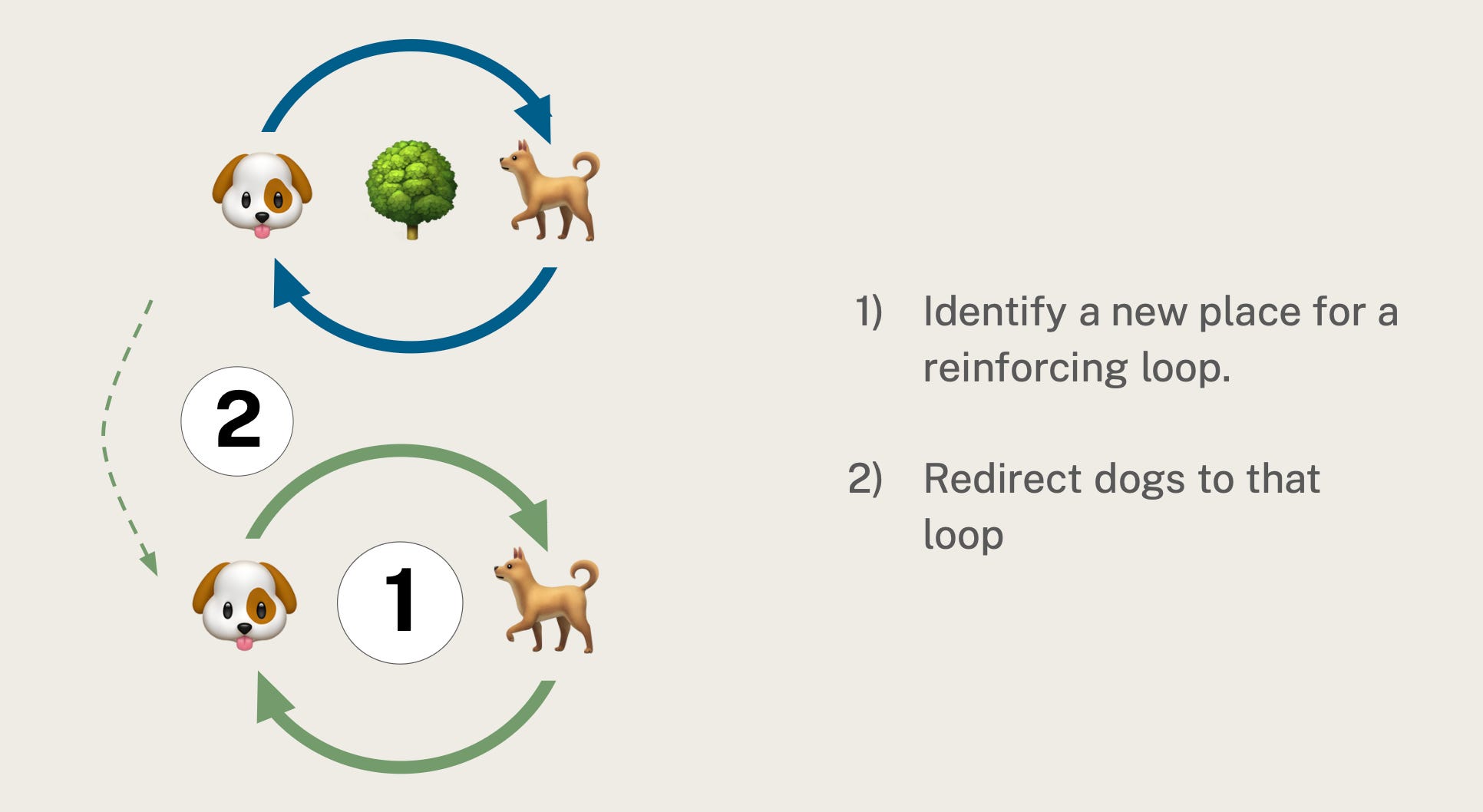
Dogs tend to pee where other dogs pee. This produces a loop, which currently reinforces around places like tree beds or the sides of buildings.
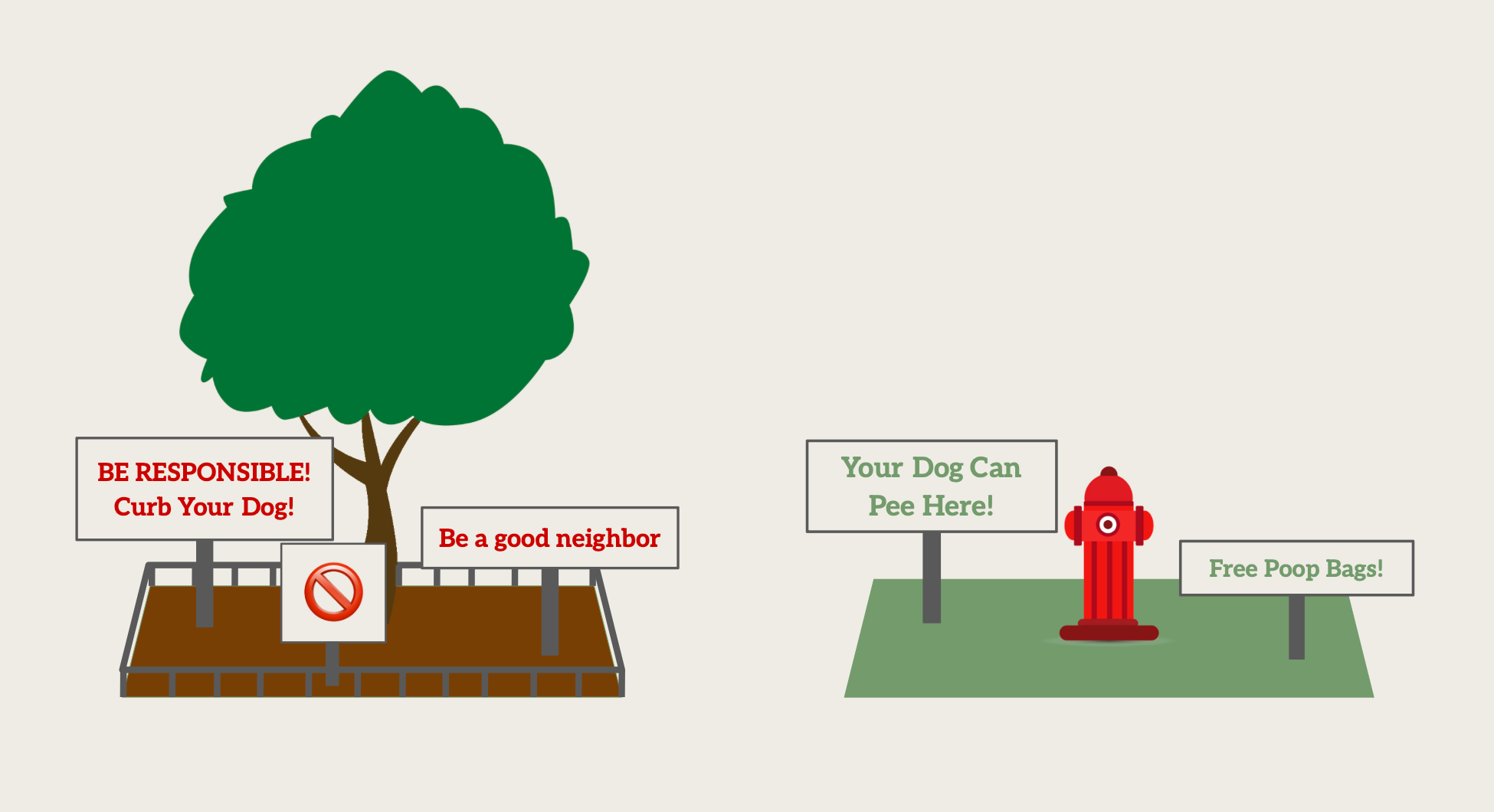
Therefore, if dogs are peeing in a place, an effective solution doesn’t try to break an existing loop, it establishes a new place for dogs to pee and redirects dogs there. This does not mean removing signage or tree guards as they can still promote compliance, but they are not a primary solution.
When behavior reinforces itself, the fastest way to change it isn’t to fight it but to give it somewhere else to go.
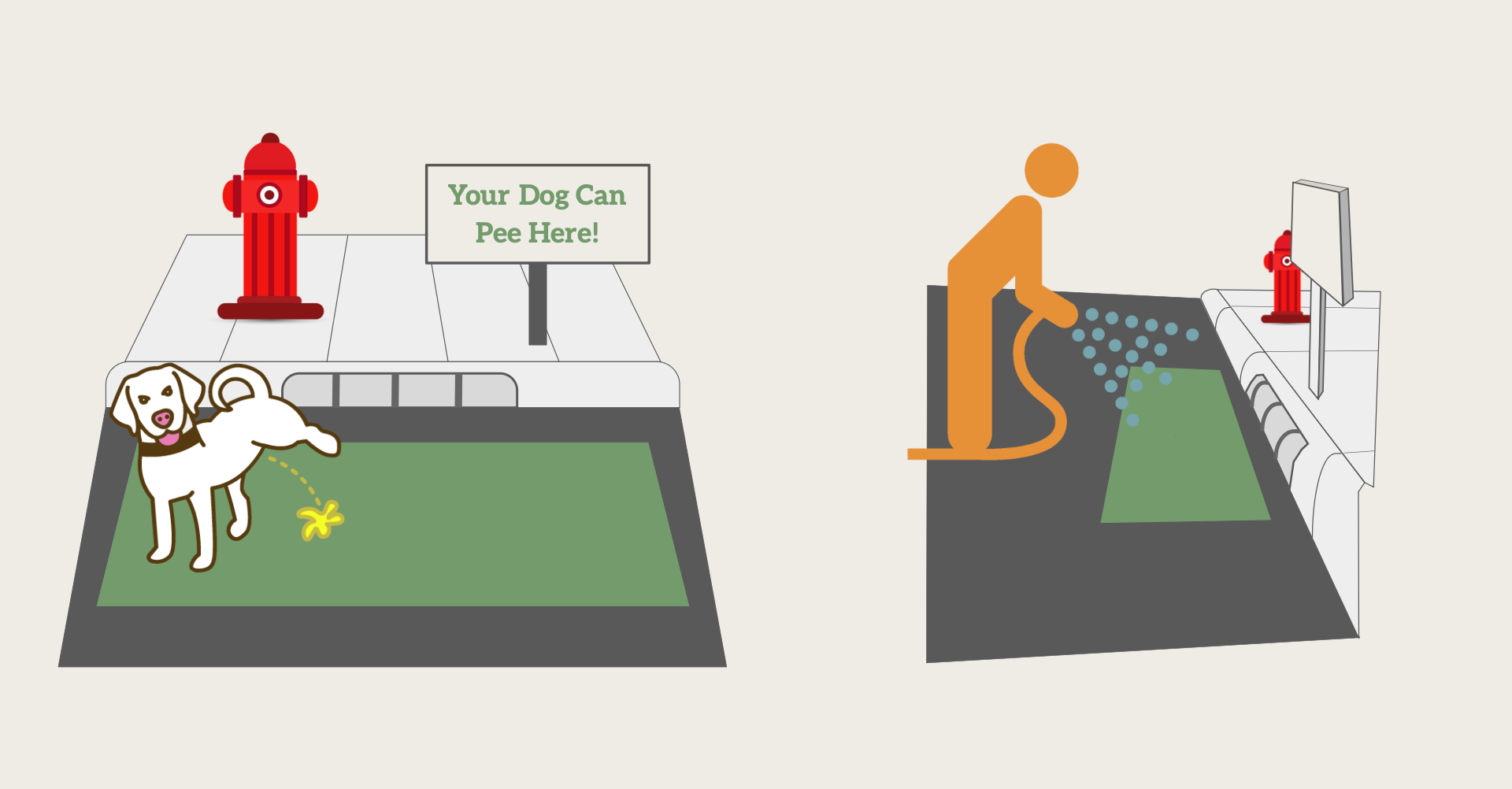
However, given that dog pee carries externalized costs — such as rust, smell, or acidifying tree beds — the place we provide for them to pee should be designed specifically to mitigate those costs. This means placing it near a hose and a storm drain.
Any intervention which attempts to get humans to change their dog’s behavior without acknowledging this loop will face resistance.
Understanding Human Behavior:
Most dog walkers let their dog lead the way. They’ll tell you they care about trees but that, in practice, convenience wins and so the easiest option becomes the default (See my dad’s anecdote).
If we don’t consider the issue of dogs peeing where other dogs pee — which it is easy not to given that unlike dog poop, dog pee seemingly takes care of itself — there are many intuitive ways to try to change humans behavior. Along with signs and fences, this might even look like adding flowers to a tree bed to appeal to the dog walkers sense of beauty. And, while it is true that these interventions likely work better than no intervention at all, they miss out on the most persuasive thing a piece of infrastructure can do: make a behavior easy.
Dog rest areas accomplish this by giving dog walkers an easy place to walk their dog where their dog wants to pee.
What would a dog rest area design need to be like?
This would need to be somewhere dogs want to pee that their owners will consistently bring them. This means it must:
Be Accessible
Advertise itself well. People need to think about bringing their dog there.
Be maintainable
Be cheap and easy to replicate
Not require enforcement
It could accomplish these goals by:
Being more desirable than other places, which could be accomplished through education, flowers, and fences on other locations
Providing free poop bags to attract walkers who might have forgotten them
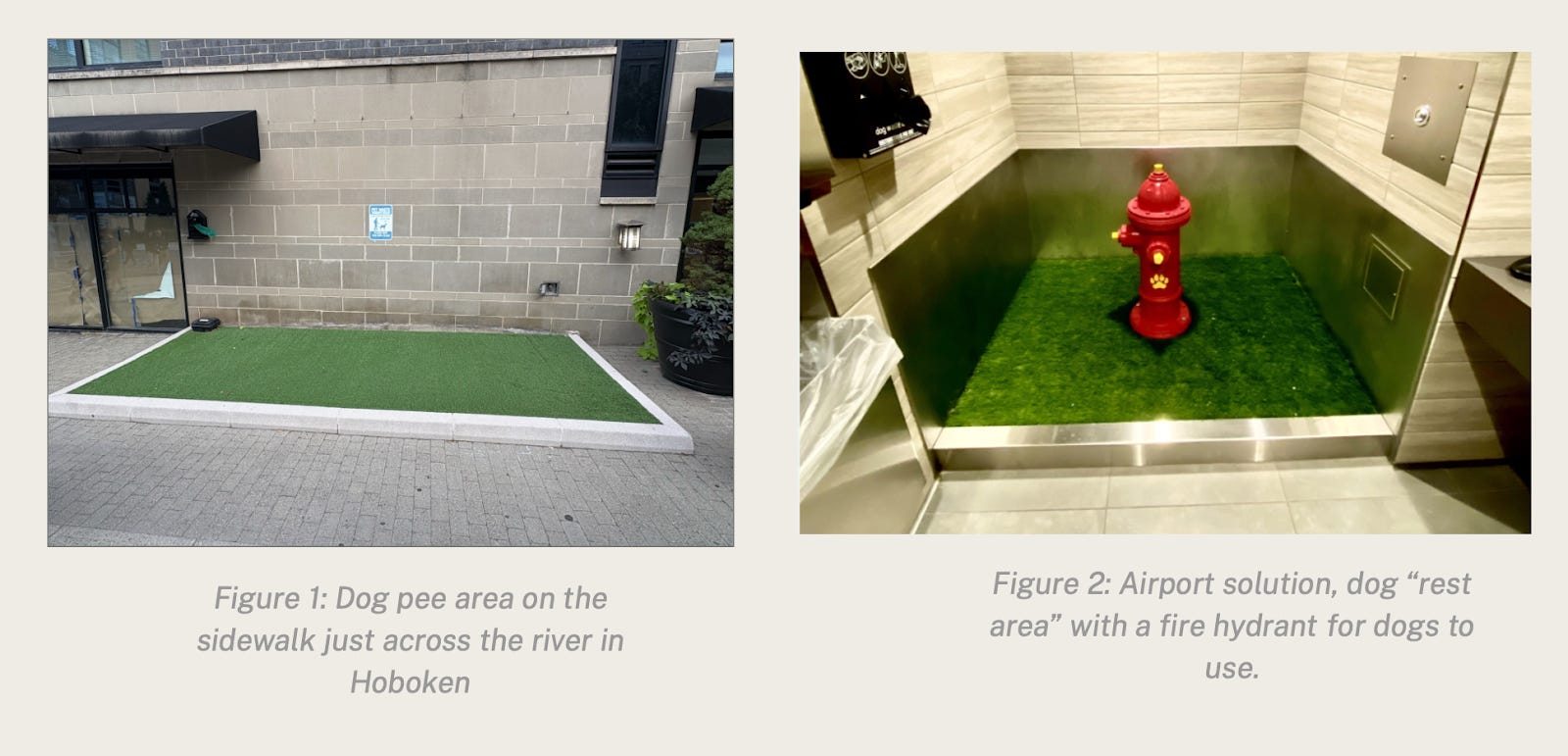
We can look to other examples for how we might accomplish this, however a slick solution in NYC, as mentioned above, is to have these be on astroturf on the curb by a fire hydrant, which is already associated with dog pee, near a storm drain so they can be hosed down easily.
The role of other interventions
The dog rest area makes the behavior easy, but as I witnessed on my block, it actually benefits from the existence of signs, tree guards, and flowers. These kinds of interventions do not work alone, as they do not address the loop, but once a place that does address the loop is introduced, they passively support compliance.
What should education be like?
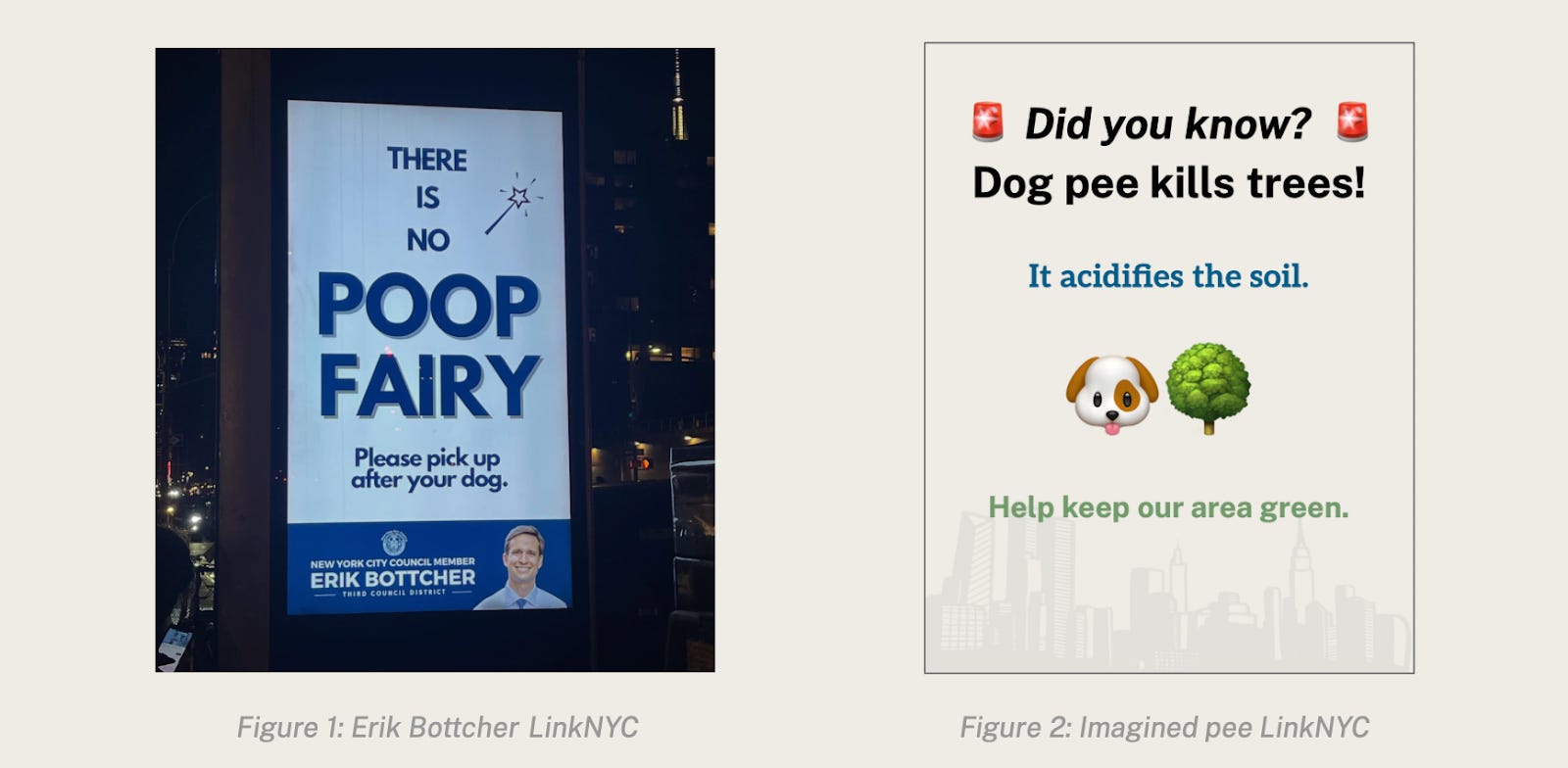
If this is an education strategy, it has to fit on a small tree sign and actually change behavior. That means:
Plain language.
Catchy and memorable.
Short enough.
Explains that it is bad.
Here are potential LinkNYC and Tree Bed Sign designs that align with this:
How can we make a tree bed a place someone wouldn’t let their dog pee?
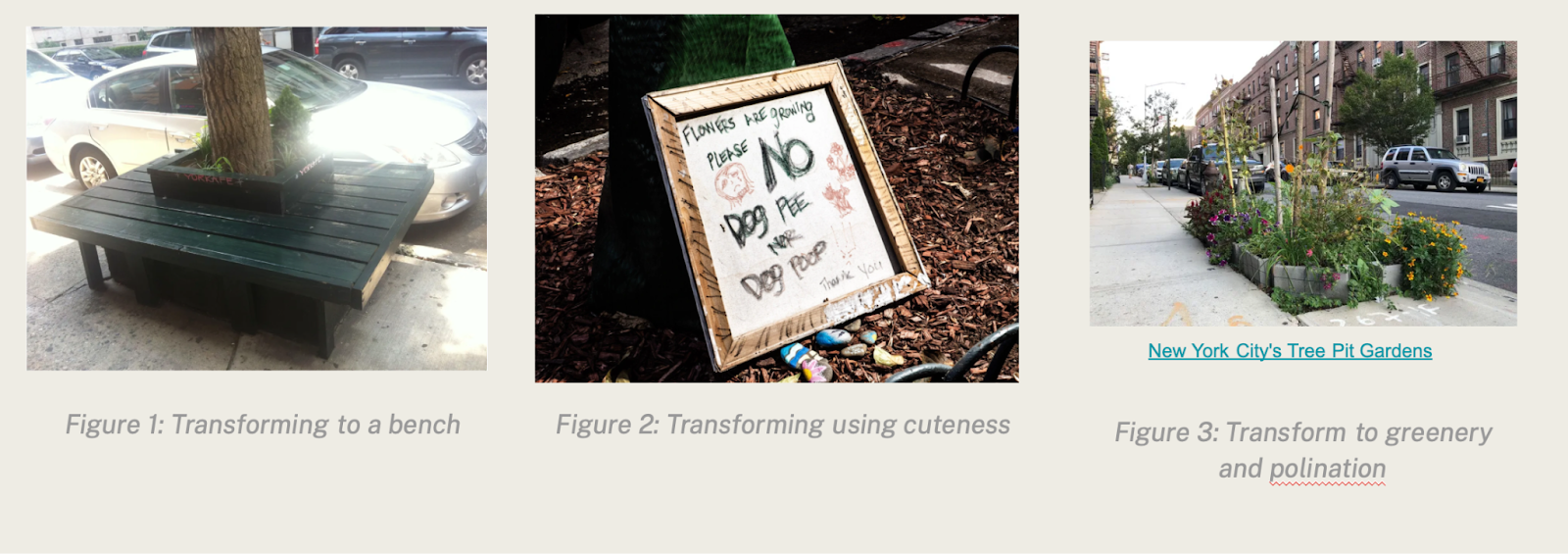
This requires identifying things people would not let their dogs pee on:
Seating: Placing a bench, table, or chairs around a tree bed.
Something Cute: Emphasizing that a child cares greatly about the tree.
Beautiful Flowers: Beautifying the tree bed and then guilting the walker.
This might be a small intervention but it points to a larger pattern: when behavior reinforces itself, design the loop instead of fighting it. For more on this mechanism, read the next piece ______.
Appendix: How to Run a Dog Pee Pilot in Your Neighborhood
Who can actually do something about this? There are many players in the fragmented NYC tree ecosystem.1 The most viable pilot partner is a Business Improvement District.
1 month pilot with a BID. Pick a sensible location, set up a pilot, advertise, monitor, iterate, evaluate.
Choosing a Pilot Location:
High dog density
Maintenance capacity
Near running water + storm drain
Ability to oversee
Visible signage
Visible site
Not served by existing dog run
Near trees so we can track change
Materials:
4’x4’ Turf square + Replacement
Sign saying: “Your dog can pee here.”
Addittional advertising signage nearby
Dog waste bag dispenser
Hydrant or visual anchor
Maintenance partner (Ideally near a hose and drain)
Volunteer or staff to inform dog walkers of pilot
Estimated Cost:
2 4’x4’ pieces of Turf: 80$
Sign: 30-50$
Additional printed signage: 5$
Bag dispenser: 20-40$
Total: Approximately 175$
Maintenance:
Daily - Weekly rinse, depending on conditions
Volunteer (me) or staff to tell people in the area of the pilot and ask them to try bringing their dog there.
How to Measure Success:
Reduced staining at adjacent tree beds (done by pre/post trial pictures? Or just watching for an hour a few different days and counting?)
Visible use within first week
Dog walkers redirect voluntarily
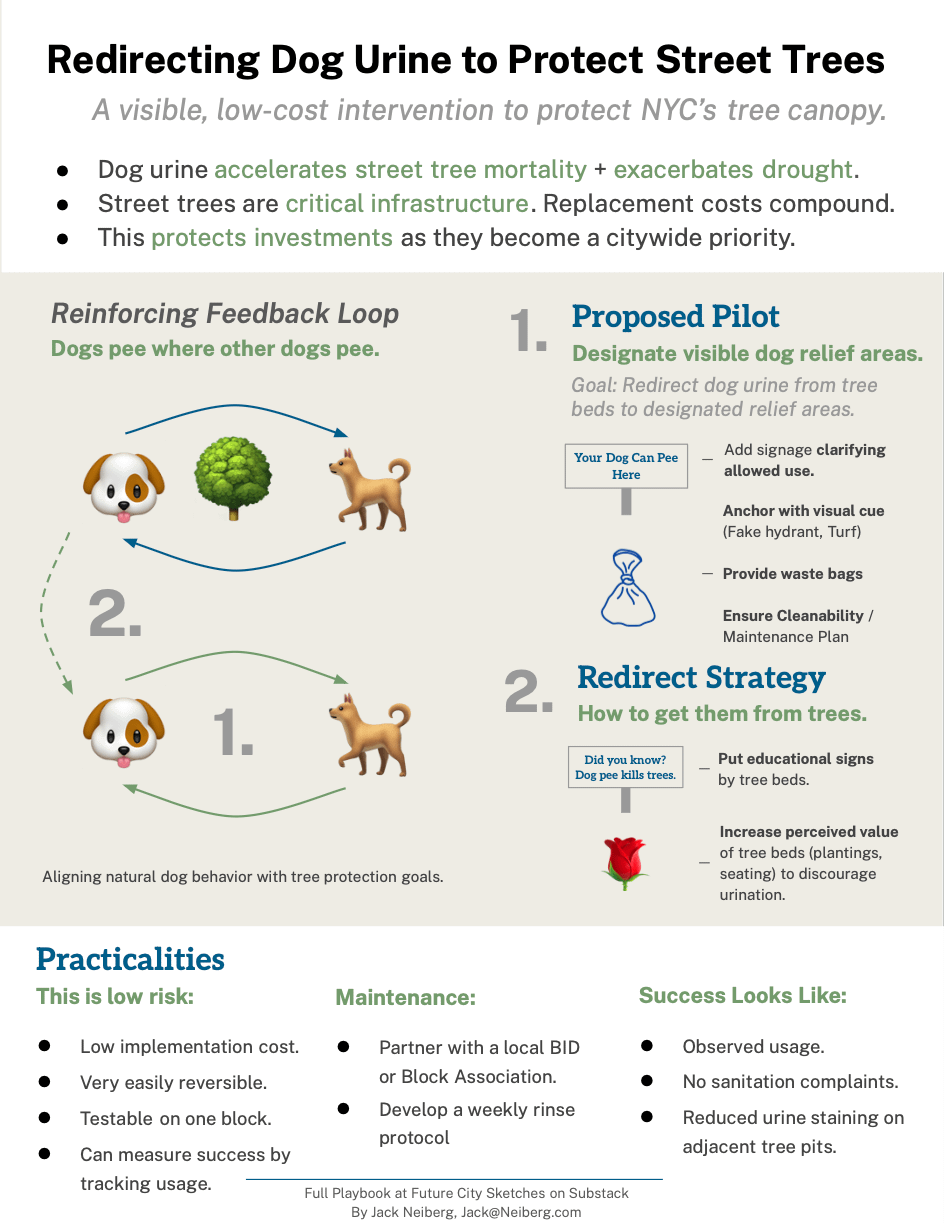
Try a small pilot with a block association or BID. Here is a one-pager I developed advocating for this proposal, feel free to use if it is helpful.

Reach out if you’d like help designing or evaluating a pilot, or just to bounce ideas!
Email me at Jack@Neiberg.com
Just to name a few: NYC Parks, Business Improvement Districts, individuals, neighborhood groups, block associations, nonprofits contracted by council district discretionary funds, park conservancies, Privately Operated Public Spaces, cemeteries, NYCHA campuses and probably more.
I found this very interesting! Other potential implementation partners: dog enthusiasts. A woman on my mom’s block keeps a treat box in front of her home for the neighborhood dogs. This type of person might be more willing to invest in this type of pilot than BIDs, though it might be tricky to find them—they need the curb space, the cash, and the enthusiasm for dogs/design!