


I will be voting yes on all 5 ballot proposals this week. But I have heard from multiple thoughtful people who will be voting no on one or more questions. Some understandably fear that losing specific hearings, veto points, or stages of input might achieve governmental speed, but at the cost of democracy or accountability. But in the same way that faster government does not necessarily mean better government, does more public review necessarily mean more democracy?
I recently encountered Layla Law-Gisiko’s article “Why I will be voting NO on All Five NYC Ballot Proposals”. Her central argument is that the proposals weaken meaningful democratic checks and shift authority toward executive agencies. She acknowledges that the government needs to become more efficient, but rejects the idea that removing formal oversight is necessarily the right way to achieve that.
I agree with her concern about losing meaningful checks on government power, but we must consider whether each requirement provides accountability that could not be achieved in a better way.
There is democratic value in public participation, but the resources we devote to it must be considered alongside other democratic values, including representation, accountability, and the elected government’s ability to deliver public goods.
We should design public review for each situation by asking what the review is meant to protect, the stakes of the government’s decision, and how to design a review process that best achieves its purpose.
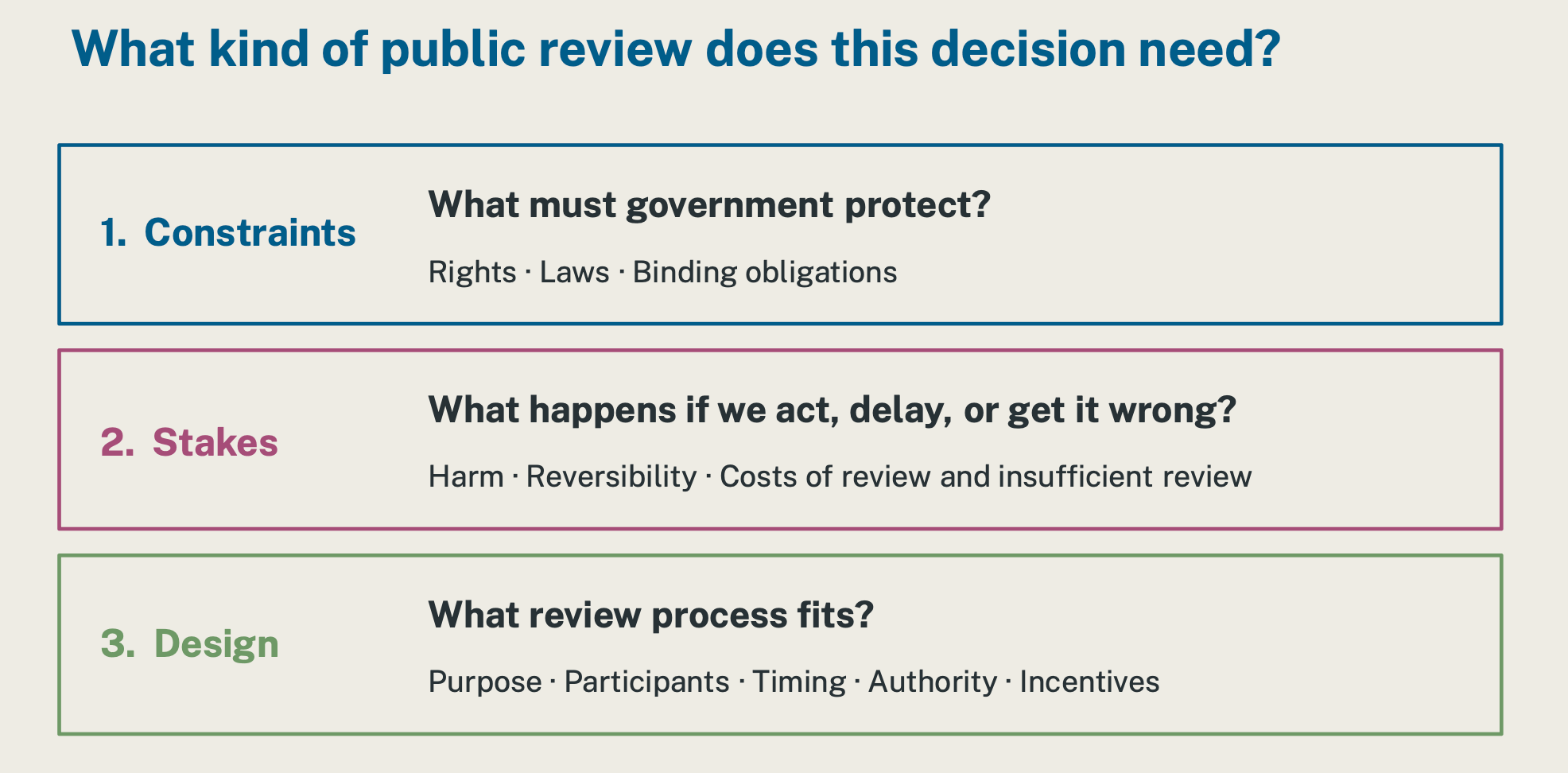
What makes a review process democratic?
Different forms of public review contribute different things to democracy, and their existence alone doesn’t tell us whether they meaningfully serve their intended purpose. Public participation, democratic representation, and holding government employees accountable are very different things.
A public hearing or community board meeting might allow individuals in the public to speak or challenge decisions without necessarily representing the desires of the broader public. A city council vote might show decisions by elected representatives, but it doesn’t guarantee a good outcome or direct participation from the public. A hearing for public review on a technical report could have no attendees but still serve a valuable disclosure function. A review requirement can also serve as a restraint on government power, letting affected people challenge or stop an action before the harm is done, but it could also become a tool for a minority to prevent positive changes that benefit the majority.
A procedure’s democratic value cannot be judged simply by counting how many opportunities to intervene exist.
What should public review accomplish?
There is serious value to getting public input on governmental decisions.
Public review is effective for informing a design. If you’re redesigning a street, you need to understand stakeholder’s needs, as people who live and work there know things that could improve the design. A Community Board doing their best to find a problem might actually identify a problem that the designers missed and improve the outcome. This function does not need a representative sample, only those most affected or most scrutinous.
Public review can also be valuable to get a sense of public sentiment about a project. It lets people voice their opinion on a change their government is making, such as a public hearing on a land use change. This kind of hearing is affected by whether it has a representative sample or only a loud minority. There is still value in understanding a strongly held sentiment even if it is not held by the majority, but this is not the same as a democratic mandate and we must design public review accordingly.1
Public review has another important function: making sure government officials can explain and defend their decisions, which should put pressure on them to keep up a high standard of work. This transparency can matter even if the public is not involved in the decision making process. Being able to see the alternatives considered and understand why a certain decision was made is fundamental to democratic institutions.
Public review can also protect people from government decisions that would harm them. It can mean giving affected people a way to challenge a decision, require a correction, or, in some cases, stop a project. The Power Broker is a reminder of why those protections matter when the government has enormous power over people with little influence. But the power to object is different from the power to veto. A veto can protect someone from arbitrary action, or it can let a small group block something that benefits many more people.
But there is a distinction to be made between a decision that violates a legal right and a lawful decision that people believe will cause harm. We have laws, agency compliance procedures, and courts to constrain what the government is allowed to do. Public review can help reveal problems that those mechanisms miss, and helps people contest policy choices that are lawful but still consequential, but it is only one of several checks on government power, and those checks do different jobs.
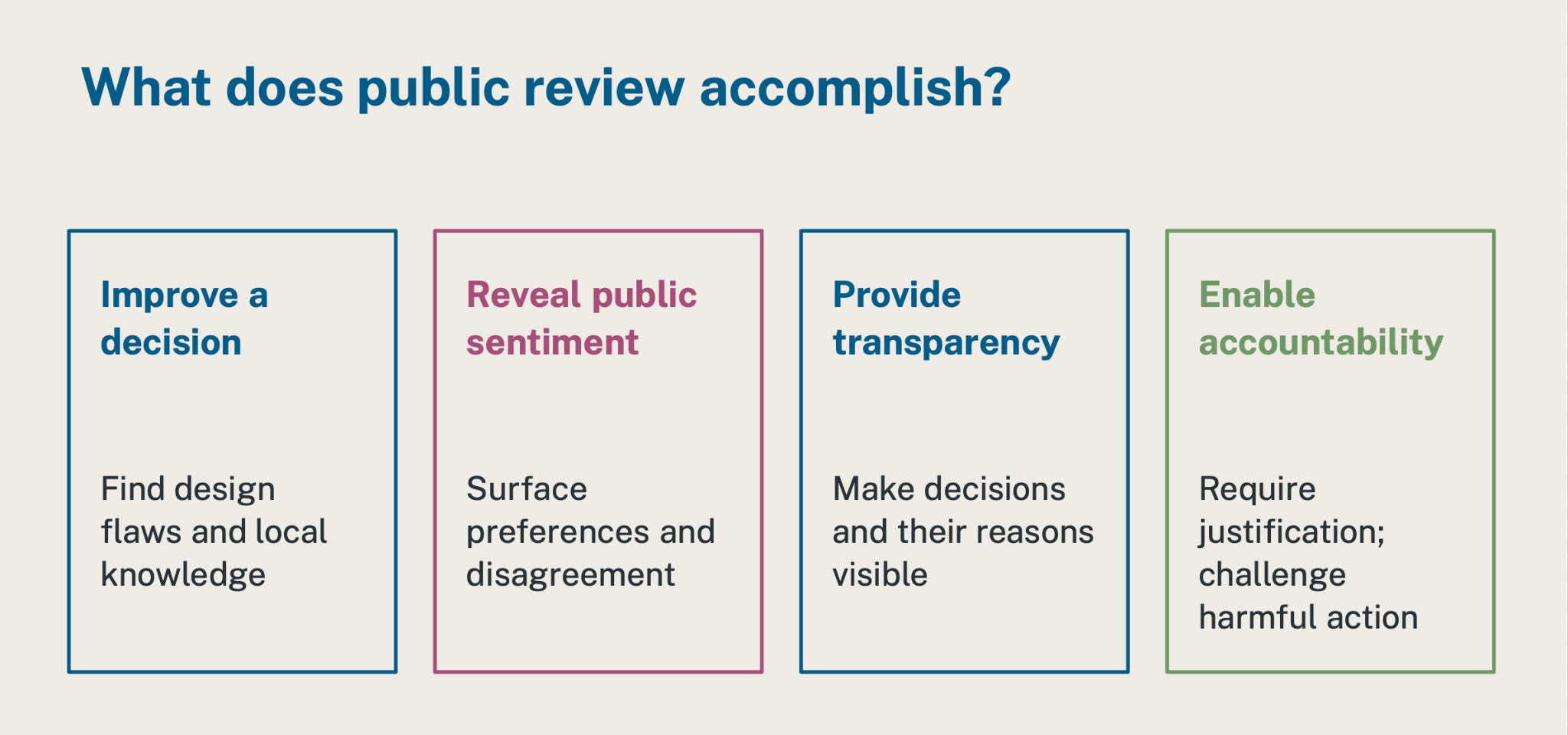
These are real and important values created by public review. The cost of losing these functions could include expensive redesigns or the loss of governmental legitimacy. But these risks are not the same for every project, and there are also costs to public review.
Review has costs. So does its absence.
The amount of review should relate to the reversibility and stakes of a project. Repainting a street is relatively easy to undo if something goes wrong. Pouring concrete, building on an empty lot, or selling city-owned property are harder to reverse. These decisions warrant different thresholds of scrutiny. However the stakes of a badly done reversible action, like someone being injured on a poorly designed painted street, can’t be undone and must also be considered.
In the same way that there are costs to not doing public review, there are also costs of public review. There are administrative costs: it takes staff time and money. There are delay costs: a delayed street-safety project might cost human lives. If the status quo is more dangerous than the proposed change, a slow review process isn’t a neutral choice.2
Review also imposes opportunity costs. Money spent on public review could be used to do more projects and provide benefits for more citizens. Or, if review makes desirable projects infeasible because the projects now don’t pencil out, the review might not have anything to protect.3
With the stakes in mind, the review should be designed to fit the situation.
So, what should the review process look like?
More important than whether there is review or not is whether the review comes at the right time, involves the right people, and grants them the right authority. Public review needs to be designed with these factors in mind:
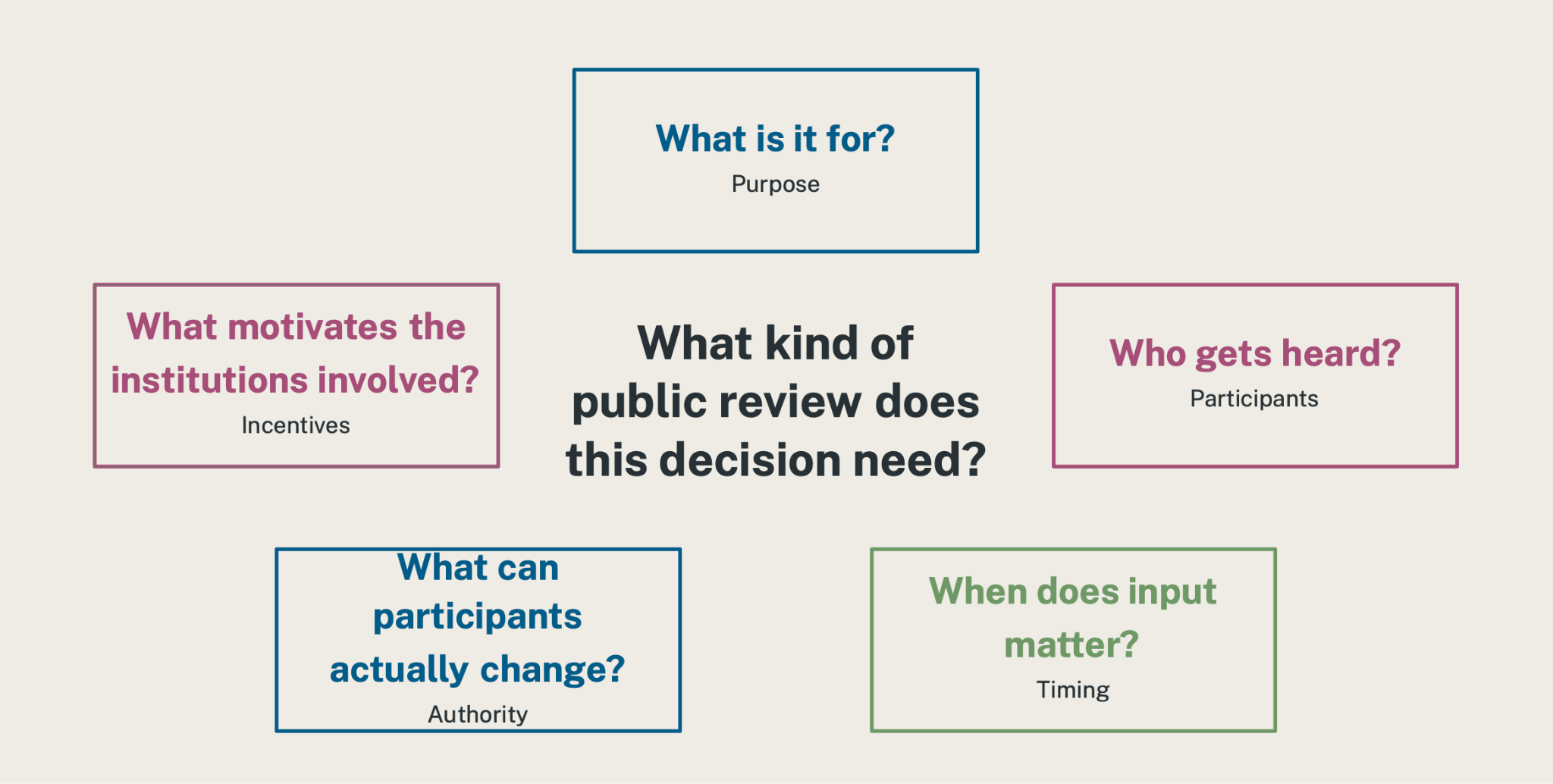
Purpose
What is this review supposed to accomplish? Is it meant to protect a right, uncover harm, create accountability, inform a design, unveil sentiment, or provide a political check on a decision that people disagree with? These are different reasons for reviewing a project, and they justify different powers. Its purpose should ground all other decisions about designing a public review process.
Participants
Who should participate in the public review? People affected directly by a decision? People affected indirectly by a decision? Is the topic of the review accessible to the public?4 Participants are not always representative of the public. A loud passionate minority can easily outrepresent a dispassionate or busy majority. Hearing from people who are passionate is important, but it is not the same as a representative sample.
Timing
When is the public review happening? The same review process could be significantly less democratic solely by happening too late. Bringing people in early, while plans are still in development, is different from completing a massive study, developing a plan, and then presenting it to the public, when changing anything would be costly. Sometimes having both can be valuable. Public involvement can also be embedded throughout the process.5 However, sometimes public involvement can serve only to delay a decision that has already been made.
Authority
Who should be able to stop a government decision, on what grounds, and with what accountability for using that power? A right that the government must respect is different from a policy preference that a small group wants to enforce. If the concern is that a decision violates a right, maybe the safeguard belongs in law, administrative review, or a court rather than in a community board veto. If the concern is a contested policy choice, maybe it belongs with elected officials or an agency acting under delegated authority. More than how much power reviewers should have, we need to ask which institution should exercise it.6
Incentives
Ideally these processes would be optimized to the best interest of the system, but an agency might prefer to do less work and a community board might prefer to keep advisory authority to maintain influence. In the case of a mayorally appointed charter commission, they could write questions that give mayoral agencies the power to remove public review with impure intentions. This does not invalidate a proposal that changes public review on its own merits, but it is worth noting.
Ballot Question 1: What review is worth keeping?
To understand this better, let’s hone in on question 1 on the ballot: changing the process for receiving a “revocable consent” to use public space.
For someone applying for a revocable consent to use public space for accessibility ramps, benches, roadway dining, and more question 1 would reduce the mandatory notice period for a hearing, remove the requirement that applicants pay for newspaper advertisements, and most importantly, it would give the relevant agency discretion over whether to hold a public hearing or not.
Sidewalk cafes currently have their own revocable consent process. Community Boards get a chance to review, and certain CB recommendations trigger a mandatory DOT hearing. The city council also has a 2-week window to disapprove of an application once DOT has approved it. Ballot question 1 would bring the revocable consent process for sidewalk cafes back in line with the new process for all other revocable consents.
From what I can conclude, the strongest reason for this additional review is that sidewalks are on the public right of way and can harm accessibility. This is a valid concern, so the loss of procedural steps deserve scrutiny. However, the DOT must comply with applicable accessibility requirements when administering the public right-of-way. If it does prove to be harmful, sidewalk cafes are also reversible. Though, despite being called a “revocable” consent, it would likely not be pleasant to ask a restaurant that has just spent time and money to move the sidewalk cafe they were just allowed to set up.
The existing review looks to find these flaws before implementation, but does the existing veto catch harms that other safeguards would miss? This requires that community boards unveil the relevant problems that the DOT would not find on its own,7 assumes the DOT would not listen to the community board without being forced to, and assumes that the council rejects applications in good faith. The council veto does have potentially invisible power in that it might make the DOT to address objections before a proposal reaches that stage. The open question is if this existing process actually prevents harm that the other safeguards miss.
Both the restaurant and agency have to spend staff time and money to navigate this process. Delay creates lost potential revenue to the restaurant. The opportunity costs are other projects DOT could be working on and the sidewalk cafes that were never installed because owners didn’t want to navigate this process.89 These costs do not scale with the lack of risk for some of these projects. Question 1’s proposal would retain the community board, borough president, and local city council member comment period, but let the agency choose whether to hold the hearing or not based on their assessment of the risks, reversability, and costs. This could allow the agency to skip out on a hearing for a project for which it might have value, but it also means that projects with minimal risk can have less overhead. 10
Accessibility matters. However, I am comfortable voting yes on question 1 despite uncertainty about whether DOT’s mechanisms are enough to protect accessibility without the existing review. The potential protections of the status quo do not outweigh the benefits of the proposal, given that community board input remains and potential changes are reversible. The general streamlining of the revocable consent process will produce a vibrant streetscape that supports our city’s culture and economy and will invite future rethinking of public space.
An invitation to disagreement
I understand why people fear removing checks on government power, especially if they don’t trust the government to deliver or worry about corruption, but there are real costs to public review that must be balanced. Instead of saying that all democratic safeguards are good, we should ask which specific democratic safeguards are worth preserving, redesigning, or replacing and why.
The important question for those who voted no, what evidence would convince you that a step of public review is not worthwhile? And for those voting yes, what loss of public review would be too much for you?
The tension between a government looking for feedback and a public looking to share sentiment bubbles over often. For example, once a street design project is initiated, design staff might be sent out to understand the community requirements for the redesign. If residents show up expecting a place to voice their opposition to the project itself, neither party will leave with what they came for. The agency might dismiss objections as irrelevant because it considers the underlying decision settled. Residents might conclude that the consultation was performative because the agency refuses to reconsider that decision, especially if residents believe they should have an opportunity to challenge the underlying decision. Both parties could leave frustrated despite participating in the same democratic process.
Maybe that changes how we think about putting paint down now and adjusting it later if necessary.
For example, the COGE report cites unused development rights associated with city-owned landmark sites. Currently the city must use ULURP to get approval to sell those air rights, but according to the report, the associated time and cost of that process often makes those transactions not worth pursuing. COGE estimates that by scaling back the public review, the decreased bureaucratic overhead would allow the city to realize value from something it already owns.
Some contracting, procurement, and budgeting documents are difficult to understand without specialized knowledge. Even if a review is formally accessible, the material itself might only be legible to civil servants, specialized nonprofits, advocacy groups, or lobbyists. These specialized topics still need oversight, but it matters who has the institutional literacy to engage when designing a process meant to solicit meaningful input. These topics require specific attention because the answer might not be more or less steps but instead a fundamental rethinking.
There's a small New York City government initiative called Design by Community (DxC) run by the Service Design Studio, where stakeholders are brought into designing a program in collaboration with the government.
This is not to say all objection belongs in the realm of the courts, as access to legal justice is unequal and as The Power Broker shows, legal defense can be slower than construction.
When this process was designed, Community Boards were the best way to get local knowledge, but realistically many people do not know about or attend CB meetings. Separately from the charter change, COGE says that the DOT will be creating an online comment portal to make giving feedback more accessible.
I believe there is also a cultural cost of people not believing that the public realm can be vibrant and flexible. See Permanence and the Politics of Possibility.
The provided justification for combining these processes is that right now a restaurant owner would need to submit separate requests for outdoor dining and roadway dining revocable consents and that this is an unnecessary burden for restaurants.
The COGE report estimates that the current six-to-eight-month sidewalk café approval process and three-to-five-month roadway café process would become a single process taking approximately two months, a roughly 75% reduction from an eight-month baseline (COGE Adopted Final Report, pp. 12 and 23–24). However, that estimate combines the ballot changes with related administrative improvements. In particular, DOT plans to reduce the final processing phase from 60–90 days to about 14 days through a separate backlog-clearing initiative. So the full time savings should not be attributed to the Charter amendment alone. It is fair to point out these speed increases do not come from the charter and could happen without charter change, however this alone does not mean the current charter process is well designed.